How Buyers Evaluate Customer Concentration Before a Business Sale
Customer concentration becomes a sale issue when losing one customer—or a small group of customers—could materially change revenue, profit, cash flow, or debt-service capacity. Buyers therefore review more than a revenue percentage: they test margin exposure, contract durability, collections, relationship transfer, and the time required to replace the contribution.
Written and reviewed by Antoine Campbell. Last reviewed .
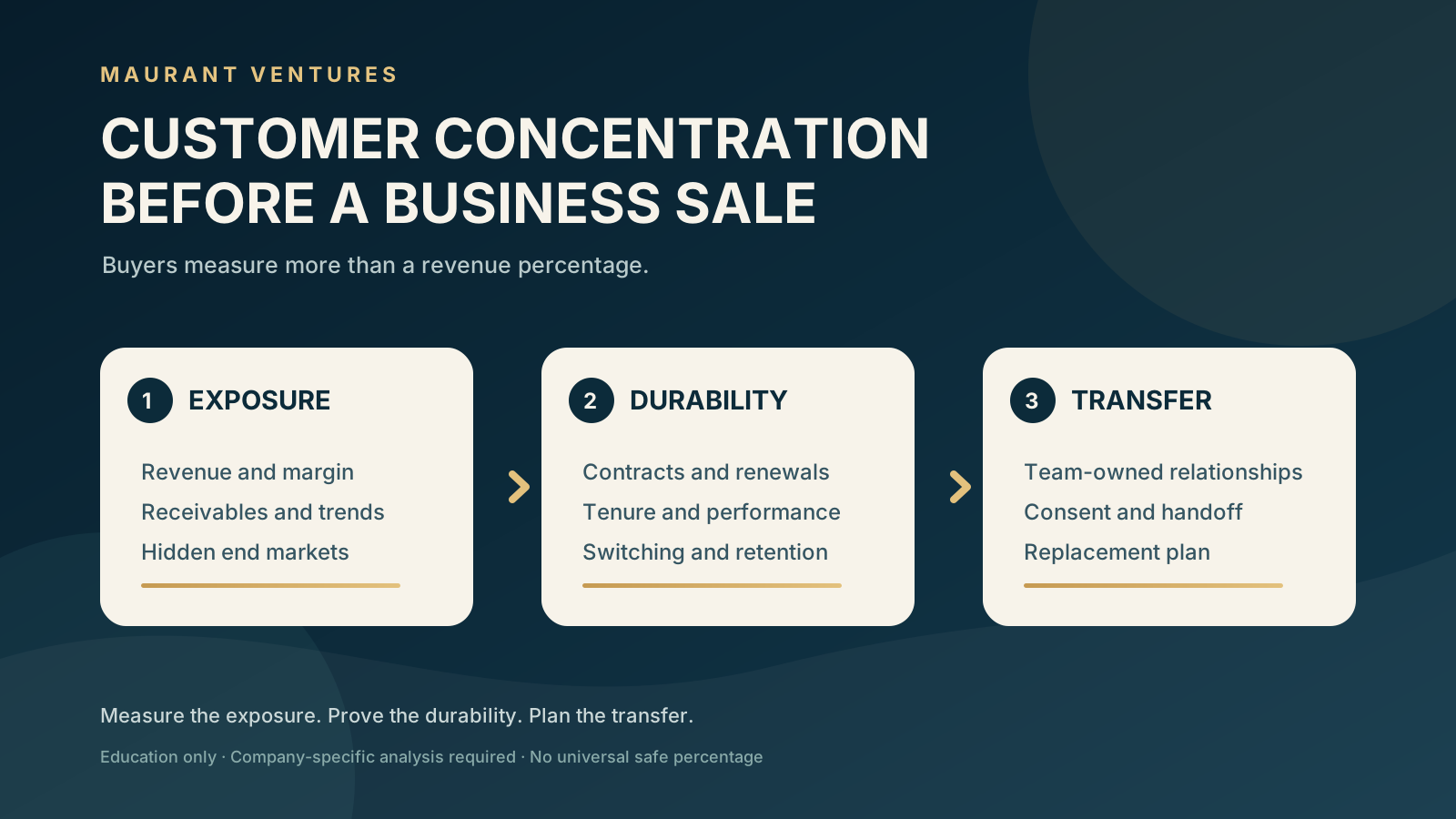
There is no universal concentration percentage that makes a private business safe or unsellable. A ten-year contracted customer with several company relationships can present a different risk than a one-year handshake account at the same revenue share. The practical goal is to quantify the exposure, prove what is durable, and show a credible transition plan before a buyer has to invent one.
This is an operating guide, not legal, tax, accounting, or valuation advice. Transaction counsel and qualified financial advisors should review the facts and transaction documents.
What customer concentration means in a business sale
Customer concentration is the share of revenue, gross profit, contribution margin, or receivables tied to a limited number of customers, contracts, referral sources, platforms, locations, or government programs.
Revenue is only the first layer. A large low-margin account can dominate sales without contributing the same share of cash flow. A smaller account with specialized labor, slow collections, or unusual warranty exposure can carry more risk than its revenue percentage suggests.
Public-company filings illustrate why sales dependence and collection exposure are separate questions. One 2025 SEC filing disclosed both the share of annual revenue and the share of accounts receivable tied to a major customer. That filing is one company’s disclosure—not a private-company valuation rule—but the distinction is useful for any seller preparing for diligence.
- Revenue exposure: top-customer and top-five revenue by month, not just the annual total.
- Profit exposure: gross profit or contribution margin tied to each major account.
- Collection exposure: receivables, aging, disputes, credits, and payment behavior.
- Operational dependency: dedicated people, equipment, inventory, locations, credentials, or workflows.
How buyers review concentrated customer relationships
A buyer usually starts with monthly customer sales for the period covered by financial diligence. Monthly data matters because a customer can still represent a large share of trailing revenue while its latest volume is already falling.
The buyer then tests why the customer stays. “They love us” is not evidence. Renewal history, service performance, recurring purchase behavior, multi-site penetration, documented switching costs, embedded workflows, and a history of resolving service failures are stronger indicators.
- Measure revenue, margin, receivables, credits, returns, backlog, and trends for the largest accounts.
- Review relationship durability: tenure, renewal history, service levels, complaints, switching costs, and the customer’s own outlook.
- Read the contracts: remaining term, renewal, termination for convenience, pricing resets, volume commitments, exclusivity, assignment, and change-of-control language.
- Test transfer risk: determine whether the company owns the relationship or the seller personally controls pricing, renewals, and issue resolution.
- Map hidden concentration: group affiliates, locations, franchises, referral sources, platforms, government programs, or common end customers.
- Estimate replacement difficulty: sales-cycle length, acquisition cost, idle capacity, specialized resources, geography, and approval requirements.
- Document management’s response plan, warning indicators, backup relationship owner, and 30-, 60-, and 90-day cash actions.
What belongs in a seller-ready concentration matrix
A concentration matrix turns account knowledge into evidence a buyer can test. Update it monthly during sale preparation and more frequently after a letter of intent.
| Field | What to record | Why it matters |
|---|---|---|
| Customer or economic group | Legal entity, affiliates, locations, referral source | Reveals hidden common exposure |
| Revenue share | Monthly, trailing 12 months, and prior year | Shows direction, not just a snapshot |
| Profit share | Gross profit or contribution where supportable | Separates volume from economic value |
| Receivables | Balance, aging, disputes, credits | Shows collection exposure |
| Contract status | Term, renewal, termination, assignment | Frames durability and transfer |
| Relationship depth | Executive, operational, billing, and field contacts | Tests company ownership of the account |
| Service dependency | Dedicated people, inventory, equipment, and geography | Estimates stranded-cost risk |
| Warning signals | Volume, price, complaints, contact or leadership changes | Surfaces deterioration early |
| Mitigation | Cross-sell, diversification, documentation, succession | Shows active management |
How to run a simple downside test
Assume a service company has $6 million in annual revenue. Its largest customer produces $1.2 million at a 35% gross margin. If $120,000 of costs can be removed quickly after a loss and replacement selling would require another $40,000, the first-pass pressure is not the full $1.2 million of revenue.
The account produces approximately $420,000 of gross profit. Subtracting $120,000 of quickly avoidable cost and adding $40,000 of replacement effort produces an estimated $340,000 of first-year cash-flow pressure.
This is a planning model, not a valuation. It excludes timing, taxes, working capital, severance, debt covenants, and the probability of loss. Its purpose is to make the operating exposure explicit.
- Model the customer retained at current economics.
- Model retention with a realistic price or volume concession.
- Model a customer loss with a realistic replacement timeline.
- Connect every case to staffing, cash, sales capacity, and debt service.
How concentration can affect price and deal structure
Customer concentration does not automatically prevent a sale. Depending on the facts, it can change diligence scope, leverage, transition requirements, price, or the timing and certainty of seller proceeds.
A buyer may request customer calls or consent, a longer owner transition, a holdback tied to retention, an earnout based on revenue or gross profit, specific contract representations, or a closing condition tied to a renewal. These are negotiated terms, not automatic outcomes.
The proposed protection should match the actual risk, measurement period, seller control, and reliability of the metric. A higher nominal price with a large, weakly controlled retention payment may carry more risk than a lower amount paid with greater certainty.
What owners can improve before a sale
Start with clean data rather than cosmetic diversification. Reconcile customer-level revenue to the financial statements, group affiliates consistently, confirm whether margin data is reliable, and resolve duplicate names, credits, intercompany entries, and pass-through revenue.
Move relationships from founder-owned to company-owned. Introduce an account team, record decision-makers and pricing logic in the CRM, and establish regular business reviews. The owner can remain involved while proving the company can serve the account through a broader team.
Centralize contracts, amendments, purchase orders, pricing schedules, and correspondence that changes commercial terms. Do not backdate, recreate, or pressure a customer into new language for a sale. Any renewal should serve the actual relationship.
Diversification usually takes multiple sales cycles. Expand proven services, channels, or end markets only when delivery capacity supports the move. If the sale is near-term, accurate disclosure, relationship transfer, and a credible downside plan can create more confidence than rushed growth.
Protect confidentiality. Do not contact a major customer about a potential sale without a coordinated plan covering timing, attendees, consent requirements, messaging, and contingencies.
What documents should be ready for diligence
- Monthly revenue by customer reconciled to the financial statements.
- Gross-profit or contribution analysis with limitations stated.
- Accounts-receivable aging, credits, disputes, and collection history.
- Contracts, amendments, purchase orders, and pricing schedules.
- Backlog, renewals, service levels, and complaint history.
- A CRM relationship map showing primary and backup contacts.
- Customer-specific employees, equipment, inventory, locations, and credentials.
- Retention, concession, and loss scenarios with a replacement plan.
- A confidentiality-controlled customer communication plan.
What Maurant needs to evaluate this
- Monthly revenue and receivables by customer for the requested diligence period.
- Reliable gross-profit or contribution data, with methodology documented.
- Complete contracts, amendments, renewal dates, and assignment provisions.
- A relationship map that shows who owns service, billing, pricing, and executive contact.
- A realistic downside plan tied to staffing, cash, sales capacity, and debt service.
When Maurant is not the right buyer
- The seller needs a guaranteed valuation, financing approval, offer, or closing.
- Material customer information cannot be supported or reconciled.
- Customer contact is required before confidentiality and consent risks are controlled.
- The proposed transaction depends on securities solicitation or commitments Maurant has not approved.
Questions owners ask
- What percentage counts as customer concentration?
- There is no universal cutoff that determines whether a private business is sellable. Buyers consider revenue and profit share, contract quality, tenure, transferability, collections, end-market exposure, and replacement difficulty.
- Does customer concentration always lower valuation?
- No. It can increase perceived risk, but the effect depends on durability, economics, growth, contracts, transferability, buyer strategy, and financing. It may affect price, structure, diligence, or transition terms in different ways.
- Should I tell my largest customer that I am selling?
- Not without a coordinated confidentiality and transaction plan. Review consent requirements with counsel and agree on timing, attendees, messaging, and contingencies with the buyer and advisors.
- Can an earnout solve customer-concentration risk?
- An earnout can share risk but does not automatically solve it. The metric, control, accounting rules, customer attribution, information rights, and dispute process all matter.
- How long does it take to reduce concentration?
- Meaningful diversification often takes multiple sales cycles. If a sale is near-term, prioritize clean data, relationship transfer, contract documentation, and a realistic downside plan while continuing responsible business development.
Sources
Request a confidential seller review
This review is exploratory and does not promise a valuation, financing, offer, or closing.
Request a confidential seller review